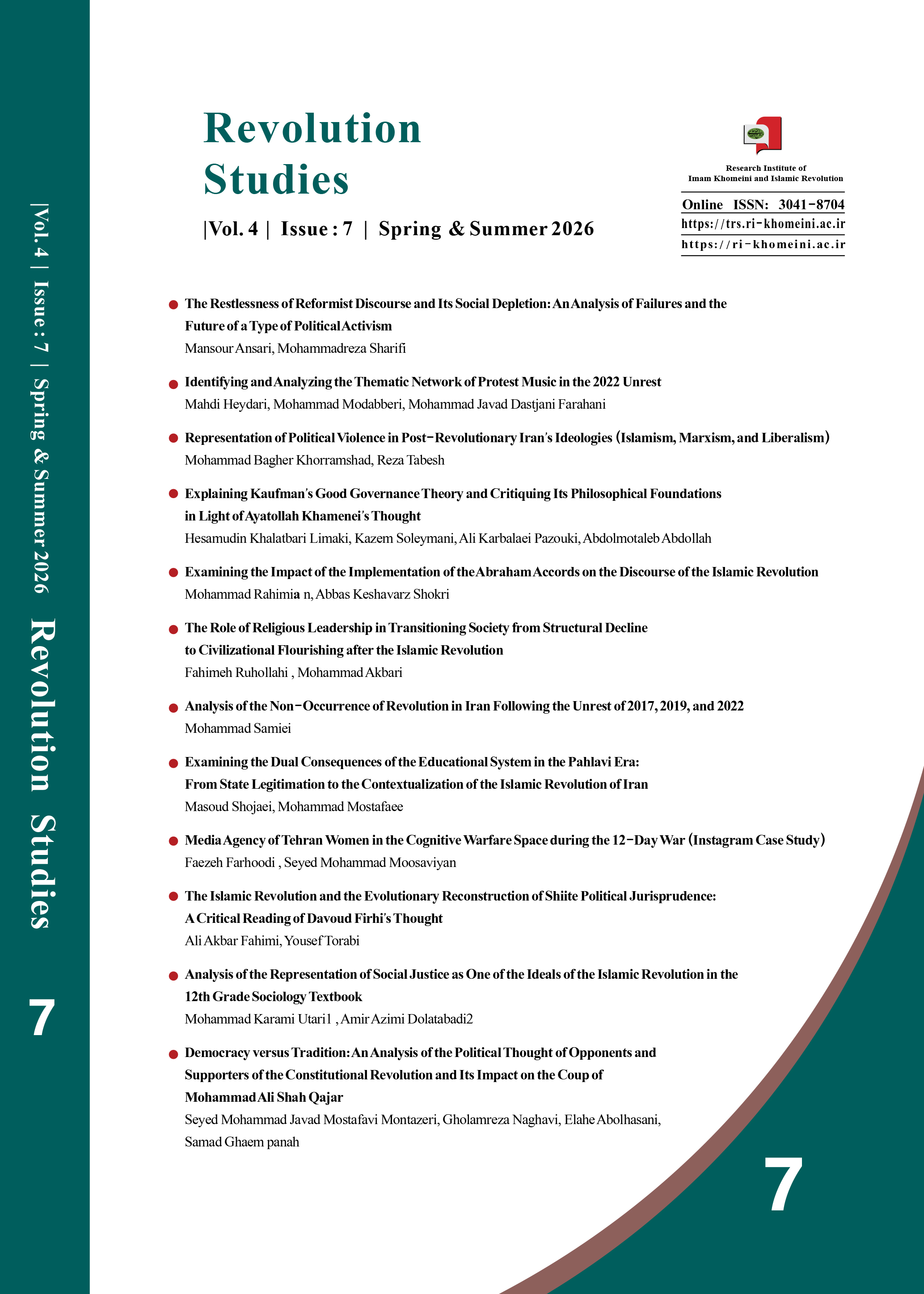
Revolution Studies

Revolution Studies

«مطالعات انقلاب» نشریه‌ای علمی وابسته به پژوهشکده امام خمینی و انقلاب اسلامی است که به صورت دوفصلنامه منتشر می‌شود. این نشریه با هدف فراهم کردن فضایی برای انتشار پژوهش‌ها و کمک به ارتقای سطح دانش و تحلیل اندیشمندان، پژوهشگران، دانشجویان و علاقه‌مندان به مباحث مرتبط با انقلاب‌ها منتشر می‌شود و پذیرای مقالات علمی-پژوهشی در این حوزه مطالعاتی است. «مطالعات انقلاب» از انتشار مقالات از تمامی رشته‌ها و حوزه‌های مطالعاتی مرتبط با انقلاب استقبال می‌کند. از پژوهشگران و نویسندگان علاقه‌مند به این حوزه دعوت می‌شود مقالات خود را به سامانه این نشریه به آدرس http://trs.ri-khomeini.ac.ir ارسال کنند .

این نشریه به شماره ثبت ۹۱۸۸۶ در تاریخ ۲۵/۰۴/۱۴۰۱ به صورت دوفصلنامه (سالی دو بار) منتشر می‌شود.


دسترسی به مقالات این سایت رایگان است

این مجله دوسالانه رایگان است. فایل PDF متن تمام مقالات منتشر شده در سایت موجود است و متقاضیان دریافت مقاله می‌توانند آن را به صورت رایگان دانلود کنند.


محل انتشار: ایران

ناشر: پژوهشکده امام خمینی و انقلاب اسلامی

ترتیب انتشار: دوسالانه

نوع انتشار: الکترونیکی

بررسی: فرآیند بررسی تخصصی به صورت بررسی بسته و دوطرفه توسط داوران ناشناس و حداقل ۲ داور و ۱ داور تطبیقی.

میانگین زمان بررسی: ۶ هفته

مهلت بررسی اولیه مقالات دریافتی: ۵ روز

زبان انتشار: فارسی (چکیده انگلیسی)

حقوق معنوی: تمامی حقوق معنوی اثر متعلق به نویسنده است.
دسترسی به مقالات این سایت رایگان است.

سرقت ادبی: به منظور جلوگیری از سرقت ادبی، از نرم‌افزار جستجوی کپی سمیم نور استفاده می‌شود.

سیاست مجله در مورد نحوه برخورد با سرقت ادبی: در صورت تشخیص سرقت ادبی در مقاله، مجله نویسنده/نویسندگان را در لیست سیاه قرار می‌دهد و اگر مقاله آنها منتشر شده باشد، مقاله بایگانی شده و زیر نام نویسنده/نویسندگان، عبارت «مقاله سرقت ادبی است» درج می‌شود.

این نشریه از اصول اخلاقی COPE پیروی می‌کند: گزینه غیرتجاری-غیراشتراکی Cc-By-4.0.

Please refer to the authors guide before submitting the article. In case of non-observance of the mentioned items, the articles will not be sent to the referees for evaluation.   


Current Issue: Volume 4, Issue 7, June 2026, Pages 1-364 

Keywords Cloud

  • Islamic Revolution
  • Revolution
  • Imam Khomeini
  • Ideology
  • Iran
  • Islamic Revolution of Iran
  • Islamic Republic of Iran
  • content analysis
  • leadership
  • Discourse
  • freedom
  • Independence
  • Political Violence
  • Islamic Republic
  • war
  • Political Thought
  • Soft power
  • Tudeh Party
  • debate discourse
  • Iran Revolution
  • Constitutional Revolution
  • Democracy
  • supreme leader
  • Social Justice
  • theories of revolution
  • the Islamic revolution
  • Protest Action
  • Coup
  • Social Capital
  • Modernization
  • Government
  • Ashura
  • Islamic society
  • Islamism
  • Constitutionalism
  • Instagram
  • Iran National Movement
  • State Building
  • Cognitive warfare
  • Laclau and Mouffe
  • future prospects
  • critical theory
  • political tolerance
  • Religious reformism
  • Political Myth
  • religious experience
  • Media Encouraging Protest
  • Political Cohesion
  • Rouhani
  • Agents of the Pahlavi regime
  • fifth generation of revolutions
  • Unrest
  • theological approach
  • intelligence failure
  • Islamic management model
  • Iran\' s Islamic Revolution
  • Lifeworld, socio-political participation, resistant agency
  • Media Agency
  • Social stratas
  • Protests (2022)
  • Discourse of exchange and competition
  • Suspension
  • Competitive advantage
  • Cultural Mediation
  • The last two decades
  • Hashemi Rafsanjani
  • Collective Consciousness,
  • PahlaviII
  • Unintended Consequences
  • Keywords: Islamic Revolution
  • Religious Democracy
  • social freedom
  • Russia
  • Ayatollah Khamenei
  • Futures Studies
  • Regional hegemony
  • Fada\'iyan-e Islam
  • IRIB (Broadcasting)
  • Islamic teachings
  • Political Rights
  • Cultural capital
  • Oil Nationalization Movement
  • the process of the Islamic revolution
  • discourse of expediency
  • Protests, government, society, political slogans, political legitimacy
  • change and transformation
  • Social cohesion
  • economic monopoly
  • Fall of the Syrian government
  • Marziyeh Dabbagh
  • crisis management
  • Religious Social Democracy
  • Female Identity
  • theme analysis\"
  • Theological historiography
  • Representation
  • Maktab-e Qur\'an
  • civilizational excellence
  • Religious intellectuals
  • Political Islam
  • Post-revolutionary Period
  • Strategic Position
  • 1401 protests
  • Equilibrium
  • reconciliation discourse
  • discourse 12 day war
  • public diplomacy
  • dramatic
  • intellectual-political movement
  • Ali Shariati
  • paradigmatic developments
  • Personal is Political
  • Deng Xiaoping
  • Coup August 19
  • Poststructuralism
  • regime repression
  • Anti-Religion
  • culture
  • Edmund Burke
  • globalization
  • Soft War
  • Celebrityism
  • digital transformation
  • structure-agent
  • Jalal al Ahmad
  • political movements
  • Imams of the Islamic Revolution
  • Marxism
  • Users
  • political satisfaction
  • Michel Foucault
  • Ahmad Moftehzadeh
  • Meta-Synthesis
  • International System
  • Pahlavi
  • Digital Resistance
  • Feeling Deprived
  • Masoud Kimiai
  • Mahmoud Taleghani
  • Unity of Word
  • Lenin
  • political participation
  • perfect human being
  • justice-oriented fundamentalism
  • informality
  • Digital anthropology: representation of reality
  • Guardian Council
  • Sovereignty
  • Secular intellectuals
  • Government Devices
  • Near Abroad
  • Historiography
  • Ahmadinejad
  • Hindsight
  • the international
  • theocracy
  • Nojeh Coup
  • ancient Iran
  • Mass protests
  • Efficiency
  • Civil Society
  • rules
  • stages of revolution
  • government in Iran
  • Iran Monarchy Association (Tonder)
  • Role and Model
  • historical sociology
  • Islamic Resistance Unit
  • Arab unrest
  • Clash of Civilizations
  • international relations
  • Democratization
  • Marxist ideology
  • Khvishkari
  • nodal point
  • reformism
  • Positions
  • Discourse Analysis
  • Ayatollah khameni
  • Committed literature and art
  • political statement
  • Saudi Arabia
  • Robert Merton
  • revolution failure
  • freedom of thought
  • political application
  • Davoud Firhi
  • Shiism
  • Future Studies
  • religion
  • Imam Khomeini (RA)
  • Political Behavior
  • Diffusion Theory
  • Islamic world
  • Political Mobilization
  • Dariush Mehrjoi
  • New media
  • spiritual transformation
  • political monopoly
  • Protest Art