The Revolutionary Research

The Revolutionary Research

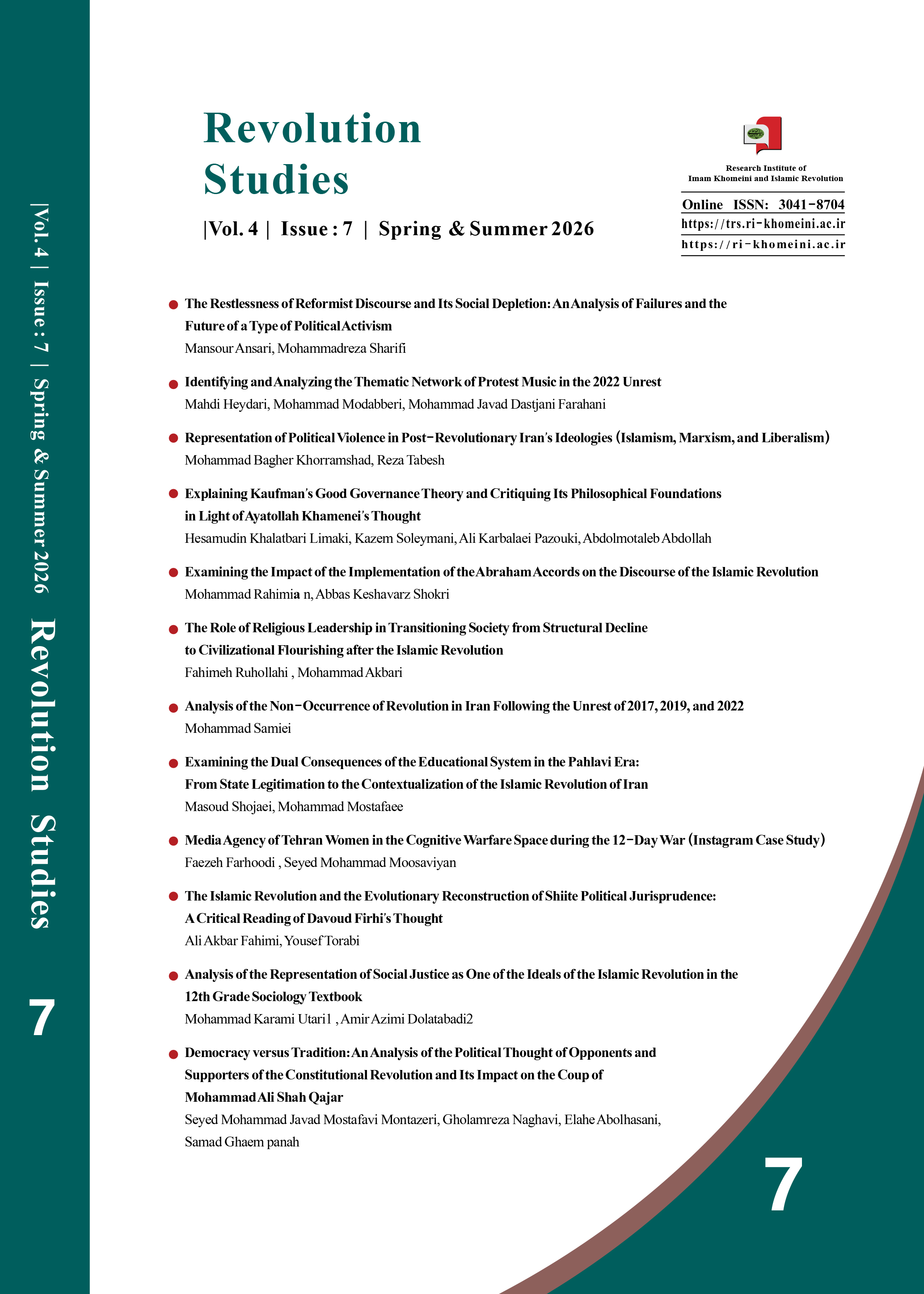
"Revolution Studies" is a scientific journal affiliated with the Imam Khomeini and Islamic Revolution Research Institute and is published bianuually. This journal is published with the aim of providing a space for the publication of researches and helping to improve the level of knowledge and analysis of thinkers, scholars, students, and those interested in topics related to revolutions, and it accepts scientific-research articles in this field of study. "Revolution Studies" welcomes the publication of articles from all disciplines and fields of study related to the revolution. Researchers and writers interested in this field are invited to submit their articles to the system of this publication at http://trs.ri-khomeini.ac.ir.

This publication is published biannually (twice a year) based on registration number 91886 on 25/04/1401.


Access to articles from this site is free

This Biannual journal is free access. PDF file the text of all the articles published on the site is available and applicants for articles can download it for free.


Place of publication: Iran

Publisher: Research Institute of Imam Khomeini and Islamic Revolution

Publication sequence: Biannual

Publication type: electronic

Review: specialized review process in the form of closed and two-way anonymous reviewers and at least 2 reviewers and 1 comparative reviewer.

Average review time: 6 weeks

Initial review period of received articles: 5 days

Publication language: Farsi (English abstract)

Intellectual rights: All intellectual rights of the work belong to the author.
Access to the articles on this site is free.

Plagiarism: In order to prevent plagiarism, Samim Noor copy search software is used.

The journal's policy on how to deal with plagiarism: If an article is found to be plagiarized, the journal blacklists the author/authors, and if their article has been published, the article is archived and under the name of the author/authors, the words " The article is plagiarized" is inserted.

This publication follows COPE's code of ethics:Cc-By-4.0 non-commercial-non-derivative option.

Please refer to the authors guide before submitting the article. In case of non-observance of the mentioned items, the articles will not be sent to the referees for evaluation.   


Current Issue: Volume 3, Issue 6, December 2025, Pages 1-317 

Keywords Cloud

  • Islamic Revolution
  • Revolution
  • Ideology
  • Iran
  • Islamic Republic of Iran
  • Imam Khomeini
  • freedom
  • leadership
  • Islamic Revolution of Iran
  • Political Violence
  • Independence
  • Constitutionalism
  • content analysis
  • Islamism
  • Coup
  • theories of revolution
  • Soft power
  • Discourse
  • Islamic society
  • Ashura
  • Iran Revolution
  • Democracy
  • supreme leader
  • war
  • Imam Khomeini (RA)
  • debate discourse
  • Political Thought
  • hard power
  • Human rights
  • Efficiency
  • Civil Society
  • Agent
  • Iranian Society
  • Balance of Power
  • Protest Action
  • National Solidarity
  • Imperialism
  • Good Governance
  • Political Islam
  • Shiism
  • Islamic Discourse
  • Religious Democracy
  • Marxism
  • critical theory
  • Discourse Analysis
  • Social Justice
  • Political Behavior
  • modern state
  • mysticism
  • Traditionalism
  • Interaction
  • second Pahlavi era
  • Ayatollah Khamenei
  • Historical approach
  • Competency
  • intelligence cycle
  • West Asia
  • modern education
  • Challenges
  • Future research
  • Women
  • monitoring
  • Students
  • Islamic teachings
  • comparative analysis
  • Political Mobilization
  • Modernization
  • Artificial intelligence
  • reflection
  • America
  • bureaucracy
  • religious experience
  • Resistance
  • China
  • public diplomacy
  • Political Development
  • globalization
  • international relations
  • identity
  • Human dignity
  • moderation
  • Progress
  • Cultural capital
  • Taxation
  • subjectivity
  • ideological
  • State Building
  • Hashemi Rafsanjani
  • Social Capital
  • Historiography
  • Governance
  • ancient Iran
  • Meta-Synthesis
  • Cultural factors
  • Thematic Analysis
  • collective identity
  • Pahlavi Government
  • Jihadi Management
  • Islamic management
  • CIA
  • Credits
  • religion
  • Tunisia
  • Constitutional Revolution
  • Suspension
  • Political elites
  • Equilibrium
  • contemporary Iran
  • Sociology of Religion
  • Freedom of Expression
  • the Islamic revolution
  • Bourdieu
  • Guardian Council
  • land reforms
  • rules
  • International System
  • Morteza Motahari
  • Ali Shariati
  • Foucault
  • Development
  • crisis management
  • Smart power
  • socialism
  • Qualitative Content Analysis
  • Huntington
  • Rentier Government
  • scenario writing
  • confrontation
  • Regional hegemony
  • Presidential Election
  • deprivation
  • Clash of Civilizations
  • Michel Foucault
  • Diffusion Theory
  • Ahmadinejad
  • Iranian revolution
  • western modernity
  • cultural revolution
  • Islamic system
  • Velayat-e faqih
  • Shiite political jurisprudence
  • Antagonism
  • government in Iran
  • Oil Nationalization Movement
  • social freedom
  • freedom of thought
  • crises
  • Comparative Comparison
  • Tudeh Party
  • Civil liberties
  • Spiritual power
  • Strategic Position
  • Rouhani
  • political statement
  • Near Abroad
  • Exception
  • Strategic Rationality
  • Political Rights
  • Social hope
  • Revolutionary Theory
  • absolute state
  • political freedom
  • Hannah Arendt
  • Agonism
  • Post-revolutionary Period
  • Jalal al Ahmad
  • political tolerance
  • Hybrid Warfare
  • Religious intellectuals
  • Particularism
  • Cross-national analysis
  • Culture of Sacrifice And Martyrdom
  • Political Changes
  • social unrest
  • Social acceptability
  • Tragic
  • Seyed Hossein Nasr
  • Poststructuralism
  • reconciliation discourse
  • traditional religiosity
  • political movements
  • nodal point
  • The Political
  • Female Identity
  • Islamic principles
  • perfect human being
  • Imam Hussain (as)
  • Property acquisition
  • Social Philosophy
  • theocracy
  • The revolutionary process
  • the beginning of the revolutionary movement
  • the end of the revolutionary process
  • the process of the Islamic revolution
  • the beginning and the end of the Islamic revolution process
  • The theory of the evolution of the Islamic revolution
  • spiritual transformation
  • political revolution
  • Domestic construction
  • religious innovation